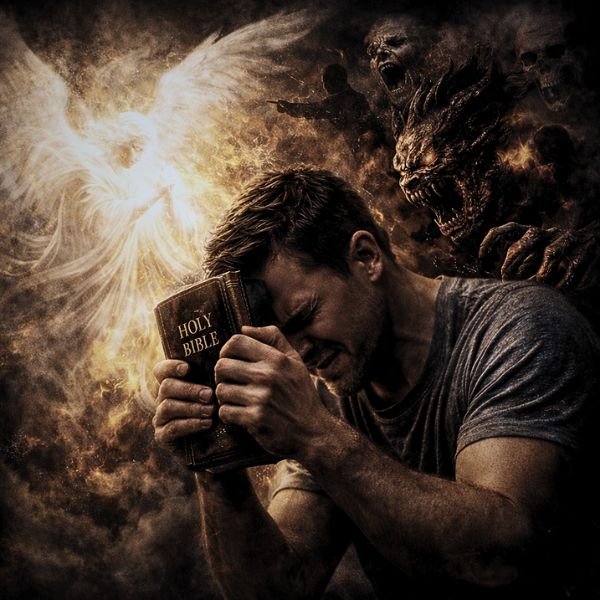
The apostle Paul gives believers a clear picture of spiritual warfare in Holy Bible (King James Version) when he writes:
“Casting down imaginations, and every high thing that exalteth itself against the knowledge of God, and bringing into captivity every thought to the obedience of Christ.”
— 2 Corinthians 10:5 (KJV)
This verse reveals that the primary battlefield of spiritual warfare is the mind. Before sin becomes behavior, before compromise becomes a lifestyle, and before unbelief becomes rebellion, it begins as a thought. Scripture calls these dangerous patterns “imaginations.”
What Are Imaginations?
In the Bible, imaginations are not harmless daydreams. They are thought patterns, mental arguments, and inner narratives that interpret life apart from God’s truth. They often appear logical, emotional, or justified, yet they oppose Scripture. Paul says they “exalt themselves against the knowledge of God,” meaning they function as rival authorities in the believer’s mind.
These thoughts may sound familiar:
“I’ll never change.”
“God won’t forgive me.”
“This sin isn’t that serious.”
“I deserve this.”
Though subtle, such ideas resist divine truth and shape ungodly belief systems rooted in fear, pride, or self-dependence.
Imaginations in the Old Testament
The Old Testament repeatedly warns about corrupt thinking. Proverbs 6:18 speaks of “an heart that deviseth wicked imaginations,” linking inner thoughts to sinful action. Genesis 6:5 records that before the Flood, “every imagination of the thoughts of his heart was only evil continually.” Humanity’s rebellion began in the mind before it manifested in behavior.
These passages reveal a sobering truth: when imaginations go unchecked, spiritual collapse follows.
How Imaginations Become Strongholds
Paul also refers to “strong holds” in 2 Corinthians 10:4. These are spiritual fortresses—entrenched patterns of thinking that resist God’s authority. They develop gradually.
First, a thought is suggested. If it is entertained rather than rejected, it gains permission to remain. James 1:14 explains that temptation begins when a person is “drawn away” and enticed.
Next, repetition reinforces the thought. When lies are replayed in the mind, they become familiar and eventually accepted. Romans 12:2 warns believers not to be conformed to the world but transformed through renewed thinking.
Then, agreement forms belief. When a person accepts a lie as truth, it becomes part of their worldview. Jesus said, “Ye shall know the truth, and the truth shall make you free” (John 8:32). Bondage, therefore, results from believing falsehood.
Once belief is established, it recruits evidence. The mind begins defending the lie and rejecting Scripture that contradicts it. Correction feels threatening. Conviction is resisted. The imagination becomes self-protecting.
Finally, belief becomes behavior. Proverbs 23:7 teaches, “For as he thinketh in his heart, so is he.” What rules the mind shapes the life. Fear produces anxiety, lust produces compromise, pride produces rebellion, and bitterness produces division.
Imaginations and Sin
Throughout Scripture, sinful actions are preceded by sinful thinking. Cain’s murder followed jealous thoughts. David’s adultery followed lustful imagination. Judas’s betrayal followed unresolved resentment. Sin is conceived in the mind before it appears in conduct.
The Word of God: The Weapon Against Imaginations
God has provided believers with a powerful weapon. Ephesians 6:17 declares:
“Take the sword of the Spirit, which is the word of God.”
The Word is not religious decoration. It is a spiritual weapon designed to destroy lies. Jesus demonstrated this in Matthew 4 when He defeated Satan’s temptations by declaring, “It is written.”
Hebrews 4:12 says that God’s Word discerns “the thoughts and intents of the heart.” Scripture exposes hidden motives and false reasoning. It reveals where thinking has drifted from truth.
The Word also replaces lies with truth. Fear is countered by God’s promises. Condemnation is replaced by forgiveness. Pride is humbled by Scripture. Psalm 119:105 reminds us that God’s Word is “a lamp” and “a light” for direction.
Meditation on Scripture reprograms the mind. Joshua 1:8 commands believers to meditate on God’s Word day and night. What fills the mind shapes the soul.
Bringing Thoughts Into Captivity
Paul instructs believers to bring every thought “into captivity to the obedience of Christ.” This requires discipline. Not every thought is accepted. Not every feeling is followed. Every idea must submit to Christ’s authority.
Philippians 4:8 provides a practical filter: believers are to think on things that are true, honest, just, pure, lovely, and of good report. Thoughts that fail this standard must be rejected.
Conclusion: Demolishing Mental Fortresses
Imaginations become spiritual fortresses when lies are repeated, believed, and defended against God’s truth. They enslave the mind and weaken spiritual authority. Yet Scripture promises victory:
“The weapons of our warfare are not carnal, but mighty through God to the pulling down of strong holds.”
— 2 Corinthians 10:4 (KJV)
Freedom is available to every believer who submits their thinking to God’s Word. Through Scripture, prayer, and obedience, mental strongholds can be demolished.
A closed Bible cannot cast down imaginations.
A renewed mind can.
Guard your thoughts.
Fill your mind with truth.
Wield the Word.
Because the battle is real—and it begins in the mind.